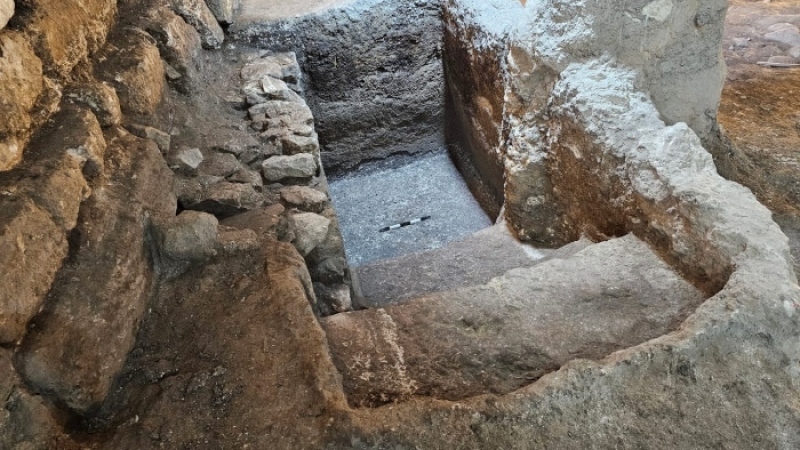
Archaeologists excavating beneath Jerusalem’s Western Wall Plaza have uncovered a rock-carved mikveh, or Jewish ritual bath, dating to the final days of the Second Temple period.
Experts say the discovery offers a rare glimpse into daily religious life shortly before the Romans destroyed Jerusalem.
The find was announced Monday following excavations led by the Israel Antiquities Authority in partnership with the Western Wall Heritage Foundation. Researchers determined that the mikveh was sealed beneath layers from the late Second Temple period and dates to around 70 A.D., the year Jerusalem fell to Roman forces.
The excavation site lies beneath the Western Wall Plaza, in an area situated between the ancient Great Bridge to the north and Robinson’s Arch to the south—two structures that once formed key access routes to the Jewish Temple nearly 2,000 years ago.
According to the Israel Antiquities Authority, ash deposits found within the ritual bath directly correspond to the Roman destruction of Jerusalem and the burning of the Second Temple. That event not only ended the Temple-centered sacrificial system but also resulted in mass killings and the dispersion of Jewish communities throughout the region.
"The exposure of a Second Temple period ritual bath beneath the Western Wall Plaza, with ashes from the destruction at its base, testifies like a thousand witnesses to the ability of the people of Israel to move from impurity to purity, from destruction to renewal,” said Mordechai (Suli) Eliav, director of the Western Wall Heritage Foundation.
The mikveh itself is rectangular in shape, measuring approximately 3.05 meters in length, 1.35 meters in width, and 1.85 meters in height. Four steps carved into the bedrock descend into the bath, whose walls were originally coated in plaster, according to the Israel Antiquities Authority.
Archaeologists also uncovered additional ritual baths and stone vessels in the surrounding area, which the authority said point to widespread practices associated with ritual purity during the Temple period.
“Among the most prominent archaeological finds representing this phenomenon are ritual baths and stone vessels, many of which have been uncovered in excavations throughout the city and its surroundings," said Ari Levy, excavation director for the Israel Antiquities Authority.
"The reasons for using stone vessels are halakhic, rooted in the recognition that stone, unlike pottery and metal vessels, does not contract ritual impurity. As a result, stone vessels could be used over long periods and repeatedly,” Levy added.
Israel’s Minister of Heritage, Rabbi Amichai Eliyahu, said the discovery deepens understanding of the relationship between faith and daily life in ancient Jerusalem.
“This moving discovery, made just ahead of the fast of the Tenth of Tevet, underscores the importance of continuing archaeological excavations and research in Jerusalem, and our obligation to preserve this historical memory for future generations,” Eliyahu said.