A nonpartisan civil liberties organization says the First Amendment does not shield protesters who interrupt worship services, pushing back against claims made after last Sunday’s disruption at Cities Church in St. Paul, Minnesota.
In a written statement by a board member, the Foundation for Individual Rights and Expression emphasized that houses of worship are private spaces, not public forums, and that entering a church to disrupt a service falls outside the scope of constitutionally protected protest activity.
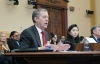
Board member Samuel J. Abrams explained that while the First Amendment strongly protects speech in traditional public forums such as streets, sidewalks and parks, those protections do not extend to private property where owners have not consented to expressive activity.
“There is no First Amendment right to enter a house of worship and engage in conduct that effectively shuts down a religious service, even as part of a protest. Nor does anybody have the right to remain on private property after being asked by its owner or authorized representatives to leave,” Abrams wrote.
He added that constitutional protections depend on clear distinctions between protected speech and unprotected conduct, noting that freedom of expression also includes safeguarding religious exercise and freedom of conscience.
"The First Amendment offers its strongest protection to speech in traditional public forums — streets, sidewalks, and parks — while also protecting freedom of association, religious exercise, and freedom of conscience. A society committed to free expression depends not only on protecting speech, but on maintaining a clear delineation between protected speech, on the one hand, and unprotected civil or criminal conduct on the other."
The clarification follows a Jan. 18 incident in which demonstrators linked to left-wing groups, including Black Lives Matter and the Racial Justice Network, entered a Sunday worship service at the Southern Baptist congregation and demanded that one of its pastors resign because of his role leading a local Immigration and Customs Enforcement field office.
The service ended early after protesters shouted at congregants.
During a subsequent interview with the church’s senior pastor, former CNN host Don Lemon suggested that storming the service constituted protected First Amendment activity. Video footage later showed Lemon entering the sanctuary with the protesters and responding to requests to leave by saying, “This is what the First Amendment is about.”
Federal authorities have since arrested three individuals in connection with the incident, charging them under the Freedom of Access to Clinic Entrances (FACE) Act of 1994, which also applies to interference with religious worship. The law prohibits intentionally intimidating or obstructing individuals exercising their right to religious freedom at places of worship.
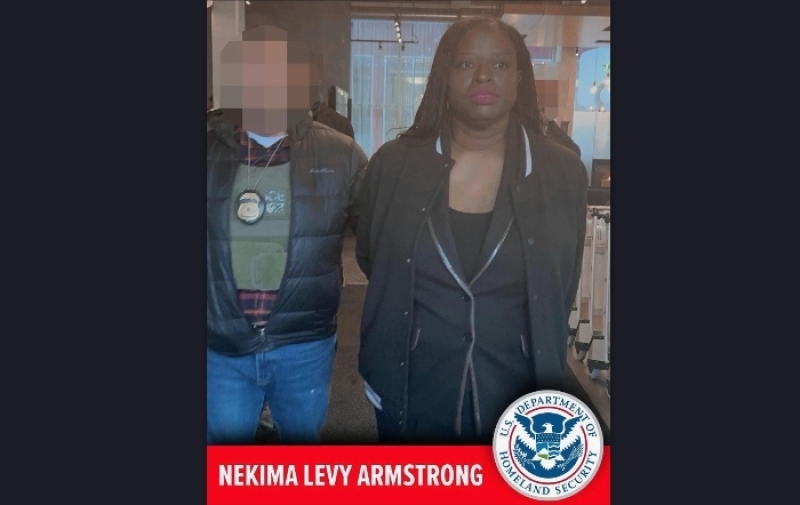
U.S. Department of Homeland Security Secretary Kristi Noem shared an image of protest organizer and attorney Nekima Levy Armstrong being taken into custody, noting that prosecutors intend to pursue charges under a federal statute addressing conspiracy against constitutional rights.
An appellate court later declined a request from the U.S. Department of Justice to pursue charges against Lemon and others tied to the protest.
Abrams stressed that private institutions, including churches, retain the right to exclude uninvited speech regardless of a protest’s political message, warning that growing confusion about the First Amendment risks eroding civil society.
“The First Amendment is often misunderstood as an affirmative license to protest anywhere,” Abrams wrote.
“It is not. It protects individuals from government suppression of speech; it does not compel private institutions to host expression they do not invite. Treating the First Amendment as a roaming permission slip for disruption misstates both the law and the logic of free expression.”